

Pardalis' Global IP
An increasing relevance to payments processing
Enterprise supply chains and consumer demand chains continue to scale in online globalized systems. The driver is the the adoption of mobile devices connecting consumers and businesses.
Mobile phones will soon become "point of sale" (POS) terminals for accepting payment from another phone. In the United States the automated clearing house network (ACH Network) annually facilitates billions of electronic transfers of money and related data. Apple, Google, Facebook, and Amazon will compete to provide mobile payments that include more than just the transactional data required by the ACH Network. Is the purchaser a "loyalty customer"? Does the purchaser qualify for a discount? Is the purchaser whom they say they are? Is the seller whom she says she is? The competitive advantage will be in efficiently providing the selective sharing of such information either as a hand-off to, or in parallel with, the ACH Network.
Pardalis' IP is now being increasingly referenced in U.S. issued patents with a nod toward access and control applicable to payments:
Parent Patent (US 696 Patent)
Pardalis filed its parent patent on August 20, 2001 and received issuance from the United States Patent & Trademark Office (USPTO) of its first patent entitled "Informational object authoring and distribution system" on December 30, 2003. US Patent 6,671,696. Here's an abstract summary:
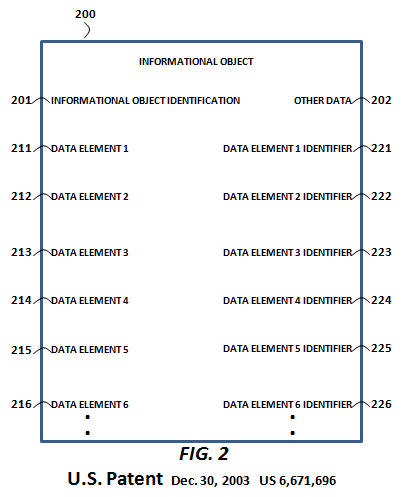
A typical immutable informational object and its contents that are authored, distributed and maintained by the present informational object authoring and distribution system comprise a unique identifier that designates the informational object, as well as one or more immutable data elements, each of which itself is identified by a corresponding unique identifier. The informational object may also contain other data, such as formatting data, permissions data, security data and the like. The data elements that are associated with a particular informational object are typically stored in a separate file system from the informational object, and are linked via the use of pointers, which comprise the data element unique identifiers.
Figure 2 is a representation from the 696 patent of a granular, author-controlled, informational object around which this patent revolves. For more information, see the blogged entry of US Patent 6,671,696: Informational object authoring and distribution system (Pardalis Inc.).
See also an unsolicited opinion by Clive Boulton at Pardalis is Banking on Granular Information Sharing.
Second Patent (US 869 Patent)
Pardalis received issuance from the USPTO of its second patent entitled "Common point authoring system for tracking and authenticating objects in a distribution chain" on November 14, 2006. US Patent 7,136,869. The 869 patent further introduces the application of owner-controlled informational objects to complex and fragmented supply chains. This patent is a continuation patent to the parent patent.
Third Patent (US 668 Patent)
Pardalis received issuance from the USPTO of its third patent entitled "Common point authoring system for the complex sharing of hierarchically authored data objects in a distribution chain" on May 24, 2011. US Patent 7,949,668. For a company news release regarding this issuance, see Pardalis announces issuance of third U.S. patent. This patent is a continuation patent to the parent patent.
Fourth Patent (US 000 Patent)
Pardalis received issuance from the USPTO of its fourth patent entitled "Common point authoring system for the complex sharing of hierarchically authored data objects in a distribution chain" on November 6, 2012. U.S. Patent No. 8,307,000. For a company news release regarding this issuance, see Pardalis announces issuance of fourth U.S. patent. This patent is a continuation patent to the parent patent.
Fifth Patent (US 765 Patent)
Pardalis received issuance from the USPTO of its fifth patent entitled "Common point authoring system for the complex sharing of hierarchically authored data objects in a distribution chain" on June 27, 2017. U.S. Patent No. 9,690,765. This patent is a continuation patent to the parent patent.
Sixth Patent (US 902 Patent)
Pardalis received issuance from the USPTO of its sixth patent entitled "Common point authoring system for the complex sharing of hierarchically authored data objects in a distribution chain" on September 10, 2019. U.S. Patent No. 10,409,902. This patent is a continuation patent to the parent patent.
Foreign Filings
Filings relevant to Pardalis' USPTO issued patents are being pursued under the Patent Cooperation Treaty (PCT) in the following countries:
- Australia
- Brazil (abandoned)
- Canada
- China (PRC)
- Europe
- Hong Kong
- India
- Japan
- Mexico
- New Zealand
Briefly comparing Common Point Authoring to the prior art
The prior art to CPA refers to collaborative document editing systems where multiple parties share in the authoring of a single document. A good example of the prior art is found in a 1993 Xerox patent entitled 'Updating local copy of shared data in a collaborative system' (US Patent 5,220,657 - Xerox) covering:
“A multi-user collaborative system in which the contents as well as the current status of other user activity of a shared structured data object representing one or more related structured data objects in the form of data entries can be concurrently accessed by different users respectively at different workstations connected to a common link.”
By contrast, CPA's methods provide for the selective sharing of informational objects (and their respective data elements) with or without the necessity of any collaboration. More specifically, CPA provides the foundational methods for the creation and versioning of immutable data elements at a single location by an end-user (or a machine). Those data elements are accessible, linkable and otherwise usable with meta-data authorizations. This is especially important when it comes to overcoming the fear factors to the sharing of enterprise data, or allowing for the semantic search of enterprise data.
CPA's methods have been further distinguished worldwide from object-oriented, runtime efficiency IP held by these leaders in back-end, enterprise application integration: Method and system for network marshalling of interface pointers for remote procedure calls (US Patent 5,511,197 - Microsoft) and Reuse of immutable objects during object creation (US Patent 6,438,560 - IBM).
CPA's methods have also been referenced in a a significant patent held by Intertrust Technologies. See Methods for matching, selecting, narrowcasting, and/or classifying based on rights management and/or other information (US Patent 7,092,914 - Intertrust Technologies). In a 2004 announcement Microsoft Corp. agreed to take a comprehensive license to InterTrust's patent portfolio for a one-time payment of $440 million.
For more information, see The Roots of Common Point Authoring (CPA).