Search
Subscribe

Bookmark and Share

Twitter Feed
About this Blog

ENGLISH
FRANÇAIS
CHINESE 中国

English

As supply chains become globalized, they are flattening ... and fragmenting. They continue to inefficiently share information "one-up/one-down". Profound "bullwhip effects" in the chains cause managers to scramble with inventory shortages and product recalls. There are hopeful signs of change. One of those is the increasing usage of personal mobile devices by managers and consumers seeking real-time enterprise information about materials and ingredient sources. Another is the push by the major search engines, (Google, Bing, Apple, etc.) for navigational "one answer" search using semantic technologies. Another may be found in the emerging (and converging) standards for interoperabile information exchange at the level of key data elements. But enterprise data is a proprietary asset that must be selectively shared to be efficiently shared. That's really a final missing piece of the puzzle to be solved for flattening the "bullwhip effect". To overcome the fear factors that keep most enterprise data locked up in data silos, the globally patented Common Point Authoring™ (CPA) system critically provides selective sharing which incorporates fixed data elements at a single location with meta-data authorizations.

Français

Comme les chaînes d'approvisionnement sont mondialisées, ils sont aplatissement ... et la fragmentation. Ils continuent à partager des informations inefficace "one-up/one-down". Profonds effets "coup de fouet" dans les chaînes de causer des gestionnaires à brouiller avec les ruptures de stock et les rappels de produits. Il ya des signes encourageants de changement. Parmi celles-ci l'utilisation croissante des appareils mobiles personnels par les gestionnaires et les consommateurs cherchent de l'information d'entreprise en temps réel sur les matériaux et les sources d'ingrédients. Une autre est la campagne menée par les principaux moteurs de recherche (Google, Bing, Apple, etc) pour la navigation "une réponse" recherche en utilisant les technologies sémantiques. Un autre peut être trouvée dans les pays émergents (et convergentes) des normes pour l'échange d'informations interoperabile au niveau des éléments de données clés. Mais les données d'entreprise est un actif exclusif qui doit être partagé de manière sélective pour être efficacement partagée. C'est vraiment une dernière pièce manquante du puzzle à résoudre pour aplatir le "coup de fouet". Pour surmonter les facteurs qui maintiennent la peur d'entreprise données les plus enfermés dans des silos de données, le monde brevetée Authoring commune Point ™ (CPA) fournit critique partage sélectif qui intègre fixés les éléments de données à un seul endroit avec des méta-données des autorisations.

Chinese 中国

随着供应链变得全球化,他们被压扁...和碎片。他们继续,效率低下分享信息“one-up/one-down”。深刻的链的“牛鞭效应”,导致库存短缺和产品召回管理人员的争夺。有希望改变的迹象。其中之一是寻求企业级实时信息有关的材料和配料的来源由经营者和消费者的个人移动终端设备越来越多的应用。另一种是用于导航的“答案”搜索使用语义技术的推动下各大搜索引擎(谷歌,Bing,苹果等)。另一种可能是在新兴interoperabile信息交流和融合标准水平的关键数据元素。但是,企业的数据是一个专有的资产,必须有选择地共享,以有效地共享。这是真正缺少的最后一块拼图,来解决“牛鞭效应”的扁平化。为了克服恐惧的因素,让大多数企业的数据锁定在数据孤岛,在全球获得专利的共点的创作™(CPA)系统严格规定的选择性共享,其中包括固定数据元素在一个单一的位置元数据授权。

About Steve Holcombe

Unless otherwise noted, all content on this company blog site is authored by Steve Holcombe as President & CEO of Pardalis, Inc. More profile information: View Steve Holcombe's profile on LinkedIn

Follow @WholeChainCom™ at each of its online locations:

Wednesday
Jan192011

The Bullwhip Effect (Part II)

Return to Part I

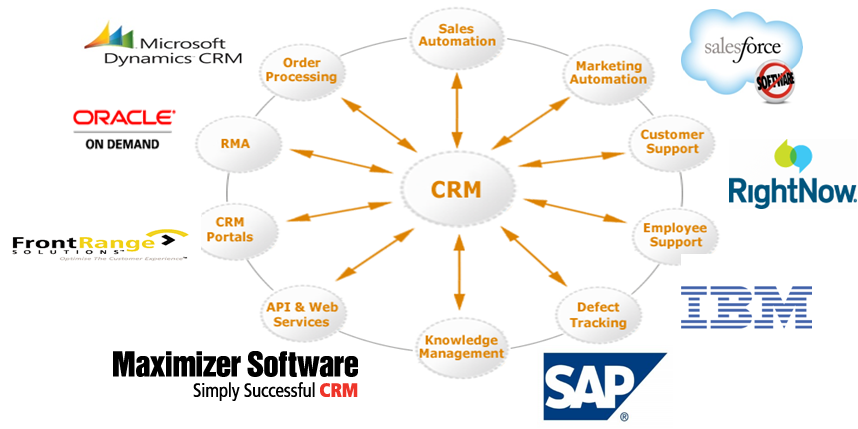
I ended Part I stating that industry had been essentially leaving the customer out of the equation, too. What I meant was that enterprise class systems like the Customer Relationship Management (CRM) Systems offered by so many companies ...

... are a significant part of the problem.

Customer Relationship Management is about companies trying to manage their prospect and customer relationships. CRM systems contribute (or, maybe I should say, reinforce) one-up/one-down information sharing in supply chains and ipso facto the Bullwhip Effect. And Michael Hinshaw makes the point that even though billions have been spent on CRM over the last 15 years ($9+ billion in 2008 alone), overall customer satisfaction has remained flat. To the right is a simpler version of CRM.

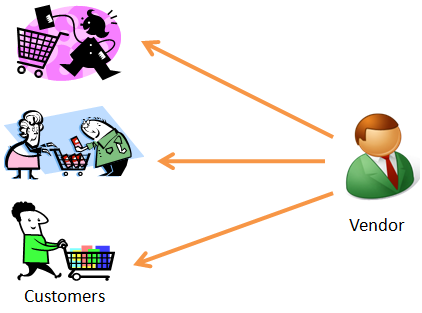
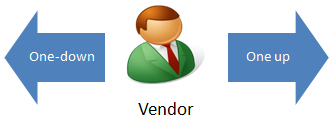
The flip-side to CRM is envisioned to be Vendor Relationship Management (VRM). VRM would provide to people – individuals who recognize their value as customers, and wish to better define the terms of their relationships – the software, tools and ability to manage their vendor relationships, as well as their interactions and experiences.

To the left is a simple picture of VRM in which a consumer is able to conveniently manage multiple vendor relationships. The critical thought leadership for VRM is found with Doc Searls and the VRM Project at Harvard's Berkman Center but VRM in the marketplace still largely remains a vision.

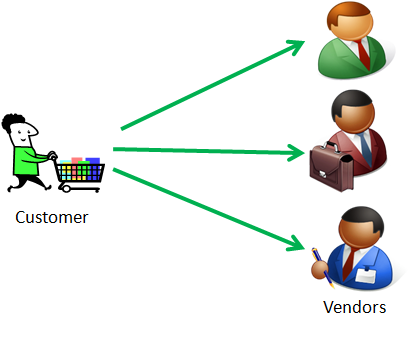
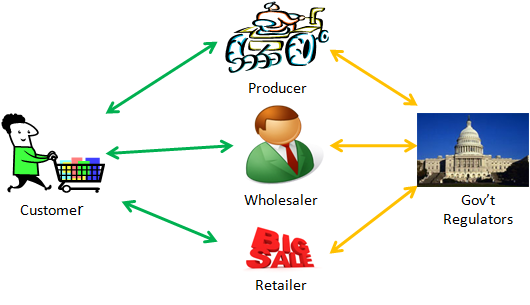
Picking back up from Part I on the concept of viewing food safety regulators as a kind of consumer, and mashing together VRM (from the perspective of customers) with a whole chain traceability system for supply chains (from the perspective of food safety regulators) it would more or less have to look like this:

"OK," you say, "that's a nice, neat, REALLY simple picture but isn't this already happening on Facebook? Can't the Customer, Producer, Wholesaler, Retailer, and even the Government Regulators all become Facebook friends and experience right now this mashed-together vision of VRM and whole chain traceability? And isn't this what Social CRM is all about?"

No, no and ... no.

The challenge is not one of fixing the latest privacy control issue that Facebook presents to us. Nor is the challenge fixed with an application programming interface for integrating Salesforce.com with Facebook. The challenge is in providing the software, tools and functionalities for the discovery in real-time of proprietary supply chain data that can save people's lives and, concurrently, in attracting the input of exponentially more valuable information by consumers about their personal experiences with food products (or products in general, for that matter). Supply chain VRM (SCVRM)? Whole chain VRM (WCVRM)? Traceability VRM (TVRM)? Whatever we end up calling it, we know we will be on the right track when we see a flattening out of the Bullwhip Effect, won't we?

On the one hand, Facebook is highly relevant to this discussion because (a) it has over 500 million users, many of them businesses and government agencies, and (b) because it has helped to raise the expectations of its users regarding the availability of - and their hunger (no pun intended) for - real-time information. On the other hand, we are a long way from seeing headlines that read "Facebook immediately identifies and confirms source of salmonella contaminated peppers" or "Facebook tracks food ingredients in dioxin scare" or "Facebookers receive real-time e. coli food recall notices based on their hamburger actual purchases".* For that to happen, we need a few more ingredients added to the mix and one of them is the metadata ...

... by which each of the participants may be empowered to keep the degree of control over their data that will free it up for real-time access (and analysis) by others. Yes, it's ironic. Give more control to consumers so as to get more, better quality data from them about their experiences with food products? Makes perfect sense to Doc Searls and the VRM folks. They get that VRM is the ironic reflection of CRM.

The other ingredients? I'll finish up with those in the next - and final - journal entry. But I will say that I'll be returning to those interesting comments made by Walmart's Frank Yiannas .....


Continued in a final Part III.

_________

* Actually, for an example of an implementation that is technically achievable right now, see my earlier blog Consortium seeks to holistically address food recalls. Substitute in "Facebook" for "Food Recall Bank".

Monday
Jan172011

The Bullwhip Effect (Part I)

There were interesting comments made last fall at the second annual meeting of the Arkansas Association of Food Protection. The comments made by Frank Yiannas, Walmart's Vice-President of Food Safety, continue to resonate with me.

The first thing that struck me was Yiannas' belief that the U.S. is currently experiencing several food safety incidents per year on the scale of the Jack in the Box incident of the early 1990's. That's a chilling perception. In the e. coli epidemic of 1993, four children died and hundreds of others became sick in the Seattle area as well as California, Idaho and Nevada, after eating undercooked and contaminated meat from Jack in the Box. It was the largest and deadliest e. coli outbreak in American history up to that time.

Another takeaway was Yiannas' belief that the food industry is consequently experiencing a "global trust bust" when it comes to food safety. 


I've been thinking a lot about Yiannas' comments and here are some of my conclusions .... 

A significant reason for the continuing series of food safety crises (notwithstanding the recent passage of the Food Safety Modernization Act in the United States) is that the food industry's global and domestic supply chains are increasingly experiencing the Bullwhip Effect. This effect is directly attributable to the inefficiencies of one-up/one down supply chain information sharing.   

What do I mean by one-up/one down information sharing? The requirement of one-up/one-down means that vendors must know what is going on inside of their four walls which means they must know what is coming in and what is going out. Representative laws or regulations requiring one-up/one-down information sharing are: 

  • EU General Food Law
  • Hazard Analysis and Critical Control Point (HACCP) plans
  • US Bioterrorism Act of 2002
  • US Food Safety Modernization Act

Industry will tell you that one-up/one down information sharing is the way it's "always been done" in supply chains. It ignores, avoids or by-passes many or most of the efficiencies of computer networking and the Internet. It also avoids or by-passes many the thorny "data ownership" and privacy issues presented by the Internet. 

But the "global trust bust" in food safety is building a fire under the boiler, so to speak. And the boiler is reaching its boiling point. It's looking less and less like things can be done the way they've "always been done".

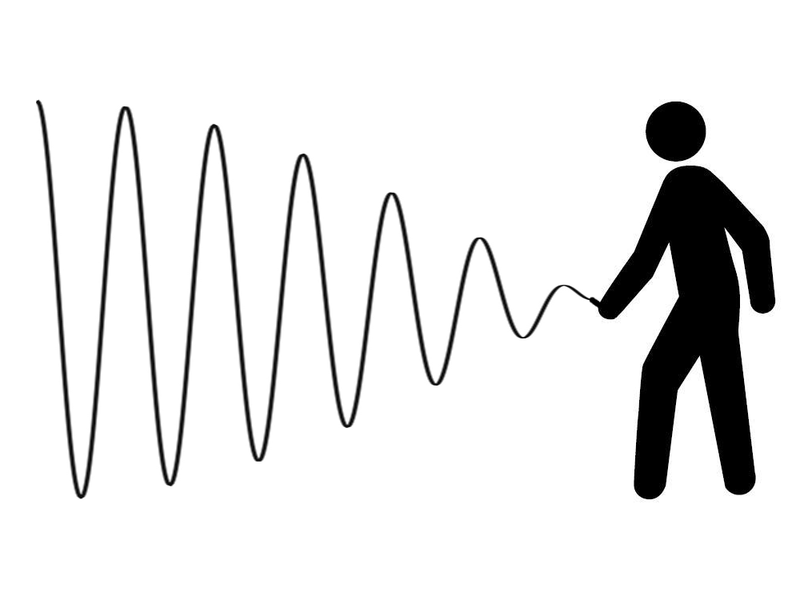
Food safety officials in a recall investigation are like consumers, albeit armed with law enforcement powers. The character above who is wielding the bullwhip could just as well be a consumer as a recall authority. The bullwhip, whether wielded by a consumer or a food saftey recall authority, is representative of a the effect of a demand.

When the Bullwhip Effect appears it is clear evidence of a less than optimal supply chain directly attributable to the inefficiencies of one-up/one-down information sharing. When a consumer makes a demand for a product, the Bullwhip Effect causes product restocking to take days, weeks, or longer ...

... similarly to how it takes days, weeks, or longer for a demand in a traceback investigation to provide the information required for determining (hopefully) the roots of the contamination and how pervasively contaminated a supply chain has become. A consumer who comes to a store to purchase a product that is out of stock causes a Bullwhip Effect in the supply chain. Similarly a food safety recall authority who comes to the store to find out why a customer became sick (or died) also causes a Bullwhip Effect in the supply chain.

OK, so you say, "What can be done about it?"

Well, the food safety recall authorities know what they want:

[T]he regulators want a traceability system that is consistent, speedy, covers the entire supply chain, has electronic records, has interoperable systems, and covers domestic and imported foods. ”


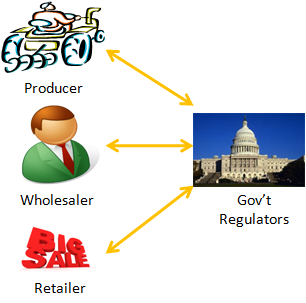
In other words, they want it all! The label they have given to what they want is a "whole chain" traceability system. A "whole chain" product tracing system consists of information elements provided by persons in the supply chain to other persons in the supply chain or to regulatory officials (e.g., during a traceback investigation). See Product Tracing Systems for Food, 74 FR 56843 (3 Nov 2009). To the right is a simple drawing of the real-time, "whole chain" monitoring that government regulators seek in order to overcome the Bullwhip Effect in food recalls.

To drill down a bit more, the government seeks to conduct real-time monitoring of the critical transactional events (CTEs) of supply chains.


And they want to see electronic one-up/one down transactional information sharing like this ...


... to become something more like this ....


The challenge for industry is that government wants "whole chain" traceability and, "[o]n top of that, [they want] industry to develop the tools and to pay for the system."

But that's a real challenge for industry if for no other reason than that the government regulators have left one critical player out of the CTE supply chain, that being ...

... the customer.

But then, come to think of it, industry has also essentially left the customer out of the equation.


Continued in Part II.


Monday
Aug022010

Consortium seeks to holistically address food recalls

The Department of Biosystems and Agricultural Engineering at Oklahoma State University (OSU BAE) is leading a multi-institutional, multi-disciplinary consortium in the preparation of funding applications for two significant coordinated agricultural projects. If successful, up to $25M for 5 years will be provided for each project beginning in 2011 under the USDA’s Agriculture & Food Research Initiative for Food Safety (CFDA Number - 10.310 - AFRI). Other institutions currently involved in this growing consortium include researchers and investigators from Michigan State University, North Dakota State University, University of Arkansas, Texas Tech University and the National Center for Food Protection and Defense, a DHS Center of Excellence. For the purposes of these activities, Pardalis Inc. is embedded within OSU BAE. The applications will be filed in September, 2010. More information can be found on this site at USDA AFRI Stakeholder Solicitations.

The vision of our consortium is to

  • advance technologies for the prevention, detection, and control of foodborne microbes and viruses in agricultural and food products,
  • manage coordinated agricultural projects with direct input from a stakeholder advisory workgroups, and
  • improve upon real-time consumer responses to food safety recalls with innovative sensor, mobile and "whole chain" information traceability technologies.

The members of our consortium have been highly influenced in their thinking by the existing data showing that many consumers do not take appropriate protective actions during a foodborne illness outbreak or food recall. The Centers for Disease Control and Prevention estimates that every year at least 2000 Americans are hospitalized, and about 60 die as a direct result of E. coli infections. A recent study estimated the annual cost of E. coli O157:H7 illnesses to be $405M (in ‘03 dollars), which included $370M for premature deaths, $30M for medical care, and $5M for lost productivity. And that doesn’t include the costs of lost sales from consumers fearful of purchasing tainted meat due to the lack of real-time, reliable information.

Furthermore, 41 percent of U.S. consumers say they have never looked for any recalled product in their home. Conversely, some consumers overreact to the announcement of a foodborne illness outbreak or food recall. In response to the 2006 fresh, bagged spinach recall which followed a multistate outbreak of Escherichia coli O157: H7 infections, 18 percent of consumers said they stopped buying other bagged, fresh produce because of the spinach recall.

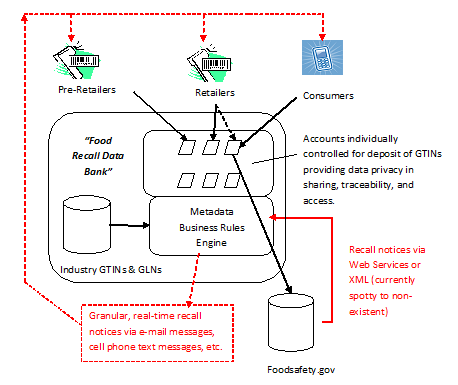
We envision the model implementation of a "whole chain" product traceability system (call it a "Food Recall Data Bank") to help solve the serious cry wolf problem experienced by consumers. The Food Recall Data Bank model would place a premium on privacy and loyalty. It would provide granular recall notices to pre-retailers, retailers and consumers. Each would centrally populate their accounts in the Food Recall Data Bank with GTIN or UPC product identifiers of relevance to their operations or consumption habits.

For instance, consumers could opt for retailers to automatically populate their accounts from their actual POS retail purchases. Consumers could additionally populate accounts using mobile image capturing applications (e.g., Microsoft Tag Mobile Barcode app). Supplemented by cross-reference to an Industry GTIN/GLN database, the product identifiers would be associated with company names, time stamps, location and similar metadata. Consumers would also be provided with a one-stop shop for confidentially reporting suspicious food to Recalls.gov.

This consortium is only just getting started. Other funding opportunities are being targeted. Let’s talk if you have a commercial or research interest in:

  • the effects of financial damages suffered by enterprises - directly or indirectly - from food safety recalls,
  • mining and analyzing the real-time data of agricultural product supply chains - including the real-time data of consumers purchasing habits, or
  • the applicability of these issues to non-agricultural product supply chains.
Thursday
May202010

Internet Identity Workshop 10 - Favorite Tweets

I unfortunately wasn't able to attend IIW 10 but did some retweeting. Here they are in chronological order -

  • RT @marcedavis learned that #infocards support LOA2 and LOA3 ("Level Of Assurance") and #OpenID does not. #iiw @ http://twb.cc/s/712 2:09 PM May 17th via tweebus
  • RT @nobantu IIW 10 - is 3 days of Open Space in the Techie Community - specifically On Line Identity - been happening for 5 yrs now #openspace #iiw 2:19 PM May 17th via web
  • RT @xmlgrrl One refreshing thing about #IIW vs other conferences: the f'in salty language. 2:57 PM May 17th via Twitter for iPhone
  • RT @mjsoaps I don't know what's more important, Identity or Reputation #IIW 7:03 PM May 17th via web
  • RT @idworkshop Day 2 of #iiw is going to be AMAZING! Here is the twitter list of attendees http://twitter.com/idworkshop/iiw10 9:37 AM May 18th via web
  • RT @xmlgrrl Once again finding myself recommending Chris Palmer's EXCELLENT talk on fixing HTTPS. Trust On First Use (TOFU)! http://is.gd/ceSc8 #iiw 12:26 PM May 18th via Twitter for iPhone
  • RT @IdentityWoman INTRO to Internet Identity Workshop 10 now up online. http://slidesha.re/cGQ3AR #iiw please retweat 5:20 PM May 18th via web
  • RT @gffletch OH "Every distributed system begets a centralized system created to make the distributed system useful" (or something like that) #iiw 7:13 PM May 18th via Twitter for iPhone
  • RT @paulmadsen Put 20 non-techies in a room and its only matter of time before somebody says 'its not a technical problem'. You never hear reverse #iiw [May 19th] via Twee
  • RT @xmlgrrl Rights and obligations of membership are nontechnical but tech may enable them (e.g. can you "unsay" something in a thread?) #iiw [May 19th] via Twitter for iPhone
  • RT @xmlgrrl =JeffH suggests looking at "operational transformation" work to solve the tech problems here. http://is.gd/cgoN5 #iiw [May 10th] via Twitter for iPhone
  • RT @rolfvb Thankyou Kaliya, thankyou #iiw - just fantastic! These seeds will lead to wonderful fruit. /cc @IdentityWoman #identity #data #privacy [May 19th] via Twitter for iPhone

I highlighted, above, the introductory presentation by Kaliya Hamlin to the workshop. Well worth a look.

For my take on IIW9 held last November, take a look at Data Identity & Supply Chains in this blog.

And for even more comments and discussion about the IIW and the "identity movement", check out the Data Ownership in the Cloud networking group on LI.

Wednesday
Apr282010

Top 12 Discussions - Data Ownership in the Cloud

Over the first 12 months of the Data Ownership in the Cloud group on LinkedIn, the following are the top 12 discussions as rated in descending order by the number of comments:

“Give Me My Data Back!” or “I want to SEE My SELF, so give me my data back, please.”
Posted by John Brian Hennessy, Entrepreneur, Start-up & Early Stage Management Consultant
54 comments

Why does data ownership matter to you?
Posted by Steve Holcombe, CEO at Pardalis Inc.
20 comments

Project VRM
Posted by Steve Holcombe, CEO at Pardalis Inc.
16 comments

The about tag is immutable
Posted by Steve Holcombe, CEO at Pardalis Inc.
13 comments

What are the security issues regarding cloud computing?
Posted by John Mooney, Information Technology and Security Solution Sales Specialist
12 comments

9th Internet Identity Workshop - Nov 3-5 - Mountain View, CA
Posted by Steve Holcombe, CEO at Pardalis Inc.
11 comments 

Firebombs & sacred cows...
Posted by Joe Andrieu, President, SwitchBook
11 comments 

Google in China - What is Going On?
Posted by Al Macintyre, Volunteer Consultant at Haiti Earthquake Disaster Relief & News
11 comments

Why Not One Big Database?
Posted by Steve Holcombe, CEO at Pardalis Inc.
10 comments

Will the next 'Google' be a traceability portal?
Posted by Steve Holcombe, CEO at Pardalis Inc.
9 comments

Is it the methods or the targets that make a hacker unethical?
From Anthony M. Freed, Director of Business Development, Managing Editor at Infosec Island Network
8 comments

Who owns supply chain visibility data?
Posted by Dirk Rodgers, Sr. Consultant, Serialization & Pedigree at Cardinal Health
7 comments

Thank you Brian, John, Joe, Al, Anthony and Dirk for posting very relevant and interesting discussions, indeed!

Page 1 ... 2 3 4 5 6 ... 36 Next 5 Entries »